


[News Release] Chill Brain-Music Interface: Using Brain Signals to Enhance the Emotional Power of Music
2026.01.26Researchers develop an electroencephalography-based system that provides real-time music suggestions based on the user's current state.
Musical chills are pleasurable shivers or goosebump sensations that people feel when they resonate with the music they're listening to. They reduce stress and have beneficial side effects, but they are difficult to induce reliably. Now, researchers from Japan have developed a practical system that uses in-ear electroencephalography sensors to measure the brain's response to music in real time and provide music suggestions that enhance chills.
Most people are familiar with 'musical chills'--a sudden, involuntary shiver or goosebump sensation that occurs when a song resonates perfectly with one's emotions. These chills are not just a surface-level feeling, but a profound neurological event. When we experience intense musical pleasure, parts of the brain's reward system activate in a manner similar to how they would respond to life-affirming stimuli, such as beloved foods or positive social connections. However, despite the universal nature of the experience, musical chills are difficult to trigger reliably. This limits our ability to harness their psychological and physiological benefits, even with today's on-demand access to vast libraries of music.
The issue lies partly in how 'personalized' media streaming algorithms are designed. These systems are essentially blind to a user's current internal state and rely instead on historical data, genre preferences, or acoustic features like tempo to suggest content. Therefore, they cannot detect whether a listener is actually connecting with a specific track at the moment to improve suggestions. But what if our earphones could read the brain's response to music as it happens?
In a study recently published in Volume 29, Issue 1 of iScience, a research team led by Dr. Shinya Fujii (Associate Professor, Corresponding author) and Dr. Sotaro Kondoh (JSPS Research Fellow, first author) of the Faculty of Environment and Information Studies at Keio University, Japan, has developed a novel solution to bring real-time brain monitoring into everyday music listening. Their paper, published on January 16, 2026, introduces the 'Chill Brain-Music Interface (C-BMI),' a system that employs compact in-ear electroencephalography (EEG) sensors to decode pleasure from the listener's brain and use that data to build an optimized playlist in real time.
The methodology involved a multi-phase approach comprising recording, modeling, and evaluation. Initially, each participant listened to self-selected songs (high pleasure) and songs selected by another participant (low pleasure) while their brain activity was monitored via the in-ear sensors. From this data, the researchers built two personalized models for each participant. The first model predicted pleasure based on the acoustic features of the music, while the second decoded the listener's pleasurable state from the EEG signals. Finally, these models were combined in closed-loop systems that generated playlists designed to either augment or diminish pleasure, with real-time neural decoding incorporated in some playlists but not others.
The results conclusively demonstrated that the EEG-updated playlist for augmenting pleasure was more effective than the other generated playlists. In other words, participants reported the highest number of chills and superior pleasure ratings when the system was allowed to adapt to their brain activity. The researchers found that C-BMI successfully captured neural markers of pleasure with high accuracy and, when using them to suggest music, outperformed the 'acoustics-only' methods that mimic current commercial streaming services.
A critical advantage of the proposed system is its size, especially when compared to brain-computer interfaces with more conventional EEG recording setups used in laboratories. "Using an in-ear EEG device with earphones offers a practical, comfortable, and accessible alternative, opening new possibilities not only for neuroscience research investigating music and the brain--which is fundamental to understanding human nature--but also for future daily applications in entertainment and human-computer interaction," says Dr. Fujii.
Notably, the research team explored how this technology could impact broader psychological well-being. Participants using the EEG-informed playlists reported higher scores in categories such as stress reduction and a sense of life purpose, showcasing the benefits of aligning music selection with a person's fluctuating internal state. "If this non-invasive system could be integrated with in-ear earphones equipped with EEG sensors and wellness and music streaming apps, it could offer emotional support during commutes, before sleep, or in daily life," remarks Dr. Kondoh.
As mental distress becomes increasingly prevalent, especially among young people, C-BMI may prove effective as a low-barrier intervention, ideal for those who might hesitate to seek traditional psychiatric care. The researchers will continue to refine the C-BMI and similar interfaces, hoping to develop systems that enhance the positive effects of the simple and universal act of listening to music.
Image
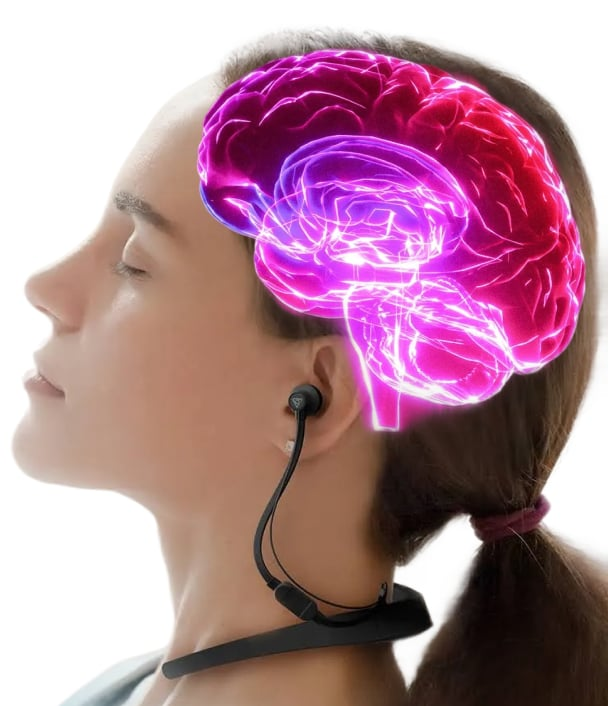
Title: Maximizing Pleasure Derived from Listening to Music
Caption: The proposed system's small size makes it a powerful tool to combat stress in daily life using optimized playlists tuned to the user's current emotional state.
Credit: Shinya Fujii from Keio University, Japan
Image source link: N/A
License type: Original content
Usage restrictions: You are free to share and adapt the material. Attribution is required. Cannot be used without permission.
Reference
Title : A chill brain-music interface for enhancing music chills with personalized playlists
Journal : iScience
DOI: 10.1016/j.isci.2025.114508
About Associate Professor Shinya Fujii from Keio University
Shinya Fujii obtained his M.S. and Ph.D. degrees in Human and Environmental Studies from Kyoto University in 2007 and 2010, respectively. He currently serves as an Associate Professor at the Faculty of Environment and Information Studies, Keio University. He is also the Director of the Neurosciences and Music Laboratory at Keio University and of the Research Center for Music Science at the Keio University Global Research Institute. Dr. Fujii specializes in perception neuroscience and its relationship with music. He has over 75 papers credited to his name.
https://neuromusic.sfc.keio.ac.jp/
https://www.kgri.keio.ac.jp/en/project/research-centers/2025/A25-27.html
https://www.k-ris.keio.ac.jp/html/100012635_en.html
https://researchmap.jp/7000025148?lang=en
About Sotaro Kondoh from Keio University
Sotaro Kondoh received his M.S. and Ph.D. degrees in Cognitive and Behavioral Science from the University of Tokyo in 2019 and 2023, respectively. He is currently a JSPS Research Fellow at the Faculty of Environment and Information Studies, Keio University, and a research fellow at the Research Center for Music Science, Keio University Global Research Institute. His research focuses on the cognitive, behavioral, and computational neuroscience of music. He is particularly interested in rhythm, musical pleasure, and the role of music in social communication.
https://neuromusic.sfc.keio.ac.jp/?page_id=2802&lang=en
https://researchmap.jp/sotaro_kondoh?lang=en
About the Research Center for Music Science
The Research Center for Music Science (RCMuS) is a research center dedicated to the scientific study of music. Guided by the principle "For the Future of Music, For the Music of the Future," RCMuS aims to scientifically elucidate the origins and evolution of music; its universality and diversity; the principles underlying the perception, cognition, generation, and creation of music; the effects of music on the brain, mind, and body of living organisms; and the impact of music on individuals, groups, and society.
The center seeks to advance research and education in music science and to disseminate the knowledge gained to the broader public.
https://www.kgri.keio.ac.jp/en/project/research-centers/2025/A25-27.html
About the Neurosciences and Music Laboratory at Keio University, Shonan Fujisawa Campus
The NeuroMusicLab at Keio SFC is dedicated to research in neurosciences and music (NeuroMusic), seeking to understand the fundamental role of music in human life. The research is founded on the premise that music provides a unique probe for identifying higher-order brain functions, including skilled motor control, learning, perception, cognition, memory, emotion, and creativity. The laboratory aims to elucidate the neural origins of human musicality, thereby enhancing the potential of music to contribute to a harmonious future. While interest in the neurosciences of music has surged globally in recent decades, Japan has historically lacked laboratories in this field. Recognizing the growing need to explore the neural basis of human musicality, Dr. Shinya Fujii founded the NeuroMusicLab at Keio SFC to fill this gap.
https://neuromusic.sfc.keio.ac.jp
Funding information
This work was supported by JST COI-NEXT (Grant No. JPMJPF2203) and JSPS KAKENHI (Grant No. 24KJ1930).
[Enquiry]
Contact: Shinya Fujii
E-mail: fujii.shinya@keio.jp